
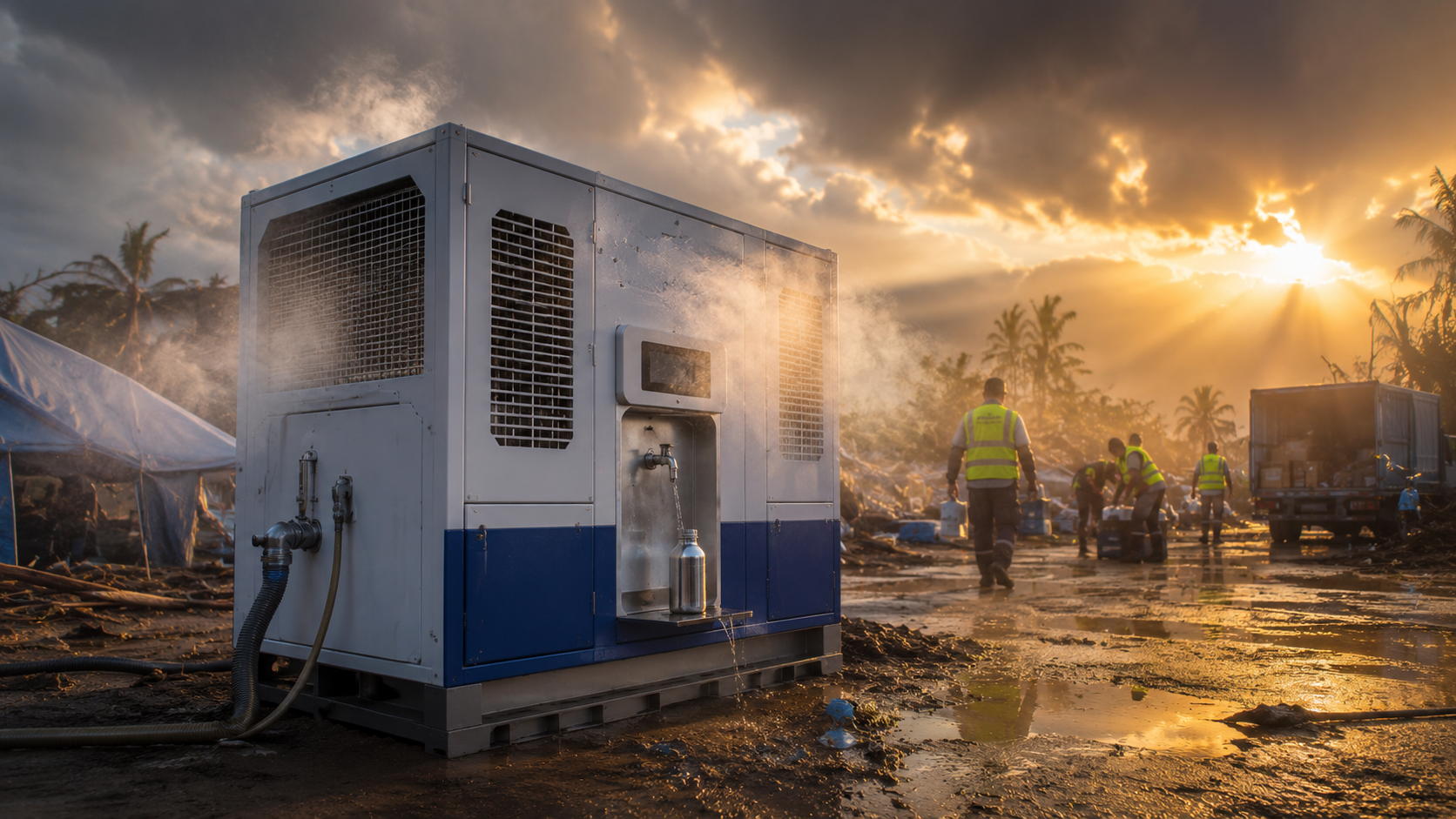

Every disaster exposes the same broken system. H2O Everywhere is replacing it.
When a hurricane makes landfall, a major pipe bursts, or a municipal water supply is contaminated, emergency managers across the country face the same immediate crisis not the disaster itself, but the water supply chain behind it.
Phones start ringing. Suppliers go to voicemail. Warehouses are tapped out. Trucking companies quote prices three times the normal rate. And somewhere between a blocked road and a flooded distribution center, thousands of people are waiting.
This is the system the United States has been relying on for decades. It is a 20th-century solution, built on pallets, diesel, and plastic, being asked to handle 21st-century disasters. And it is failing.
H2O Everywhere is building something better.
What Is Atmospheric Water Generation (AWG)?
Atmospheric Water Generation is exactly what it sounds like: the extraction of clean, pure drinking water directly from the humidity in the surrounding air.
H2O Everywhere’s proprietary AWG systems draw ambient air through a multi-stage filtration process, lower it to its dew point to condense water vapor into liquid water, then treat the result with advanced purification, producing water that meets or exceeds EPA drinking water standards, chlorine-free, PFAS-free, and entirely independent of any ground source, pipeline, or municipal supply.
As long as there is humidity in the air and a power source — whether that’s a utility grid, a portable generator, or a solar array an H2O Everywhere AWG unit is producing clean water. Continuously. On-site. Without a single delivery truck.
The water you need is already in the air around you. H2O Everywhere gives you the technology to catch it.
Why the Traditional Emergency Water Model Is Broken
The conventional approach to emergency water management is a “pull” system: you identify a shortage, then you attempt to pull resources from somewhere else to fill it.
On paper, it sounds logical. In practice, it fails at the exact moment it’s needed most, because disasters don’t just create water shortages. They destroy the infrastructure that moves water from where it is to where it’s needed.
Here’s what typically breaks down:
The Last Mile Problem
Getting water from a regional distribution hub to the actual point of need — a shelter, a hospital, a neighborhood — is the most expensive, dangerous, and failure-prone part of emergency logistics.
Flooded roads. Blocked bridges. Fuel shortages. Every obstacle between the warehouse and the person who needs water is a point where the system can collapse.
Infrastructure Dependency
Pipe bursts, power outages, and contamination events don’t announce themselves in advance. When the grid fails, pump stations stop. When mains rupture, distribution collapses.
The conventional water supply system is entirely dependent on the same infrastructure that disasters destroy.
Finite, Expiring Supply
Stockpiled bottled water has a shelf life. It expires. It takes up space. It has to be rotated, replaced, and disposed of — an ongoing operational cost that produces nothing when the crisis is calm and potentially nothing when the crisis hits.
Plastic Waste as a Secondary Disaster
Every emergency response zone in recent American history has generated a secondary crisis of single-use plastic bottle waste.
This isn’t just an environmental problem. It’s a logistics problem. Every pallet of empty bottles that needs to be removed is resources diverted from life-saving operations.
How AWG Solves Every One of These Problems
H2O Everywhere doesn’t optimize the broken system. It replaces it.
Instead of moving water to people, AWG moves the production of water to people. Every unit is a self-contained water generation facility that operates wherever it’s placed — a parking lot, a gymnasium, a hospital loading dock, a forward operating base — requiring nothing more than air and electricity.
No Infrastructure Required
H2O Everywhere’s OASIS and LAGOON units can be transported to any location, connected to a portable generator, and begin producing water within hours of arrival.
No plumbing hookup. No proximity to a water main or aquifer. No municipal connection of any kind.
Drop it, plug it, hydrate.
Radical Portability Changes the Logistics Math
The conventional logistics calculation for water is brutal: water is heavy, volume-intensive, and finite. Shipping an AWG unit fundamentally changes that math.
One LAGOON unit produces up to 1,000 gallons of clean water per day, continuously, for the life of the machine.
The MAVERICK unit is compact enough to be vehicle-mounted, providing mobile water generation for search-and-rescue teams and first responders operating in the field.
You’re not shipping water. You’re shipping a water factory.
Water Quality That Exceeds the Tap
In disaster conditions, “Boil Water” notices become the norm as contamination enters municipal supplies through ruptured mains, flooding, and compromised treatment facilities.
AWG water is inherently isolated from local ground sources. It’s generated from atmospheric humidity, filtered through multi-stage purification systems, and treated to medical-grade standards, making it not just available during a crisis, but demonstrably safer than what was coming out of the tap before the disaster struck.
Zero Plastic Waste
AWG eliminates single-use bottled water from emergency logistics entirely.
No plastic bottles purchased. None stored. None distributed. None discarded.
Operational efficiency and environmental responsibility are not in tension here — they are the same outcome.
The Financial Case: From OpEx to CapEx
Here’s a framing that resonates with every facility manager, property director, and emergency planning officer: the traditional bottled water approach is an Operating Expense model.
You pay every time you need water. During a disaster, those prices spike — trucking surcharges, fuel premiums, supplier scarcity pricing. The costs compound exactly when your budget is most constrained.
H2O Everywhere technology is a Capital Expenditure model. You own the capability. You own the “well in the sky.”
Whether the disaster is three days or three weeks, whether trucking prices triple or quadruple, your water production cost stays the same: electricity.
Over any meaningful time horizon, and especially during the disasters that happen with increasing frequency and intensity, the AWG model doesn’t just match the cost of the conventional system. It eliminates the cost spikes that make disaster management financially devastating.
Who Needs This, and Why Now
H2O Everywhere’s AWG technology is deployed across 40+ countries and 2,000+ installations, serving military forces, federal government agencies, humanitarian organizations, and international governments.
In the United States, H2O Everywhere has proposed a formal FEMA pilot program for a nationally distributed AWG emergency water network.
The U.S. Marine Corps has deployed H2O Everywhere technology in active field operations.
The applications closer to home are equally compelling:
- Hospitals and Healthcare Facilities — Water is a clinical necessity. A pipe burst that takes a dialysis center or surgical suite offline isn’t just an inconvenience; it’s a patient safety emergency and a regulatory crisis.
- Correctional Facilities — Facilities housing thousands of people have a legal obligation to maintain adequate water supply, including 72-hour emergency reserves. AWG replaces expensive, space-consuming, expiring bottled water stockpiles with continuous on-site generation.
- Property and Facility Management — From adaptive reuse housing developments to commercial properties, AWG provides a built-in safety net that protects tenants, protects occupancy, and protects property value when infrastructure fails.
- Construction and Remote Work Sites — Mobile AWG units eliminate water logistics entirely for operations in undeveloped or rural areas — no delivery scheduling, no supply chain, no waiting.
- Emergency Response Organizations — First responders, shelters, and disaster relief operations that carry AWG units with them arrive capable of generating water independently within hours, rather than waiting on supply chains that may be days behind the emergency.
The Bottom Line
The question for every facility director, emergency manager, and property owner is no longer whether infrastructure will fail — it’s when, and how prepared will you be when it does?
The organizations and communities that are investing in AWG technology right now are not reacting to the next disaster. They are already prepared for it.
They are the ones whose lights stay on, whose taps keep flowing, whose operations continue when everyone around them shuts down.
H2O Everywhere is not selling a water machine. We are selling operational independence — the capability to function when the systems everyone else depends on have failed.
The water is already in the air around you. We built the machine to catch it.