
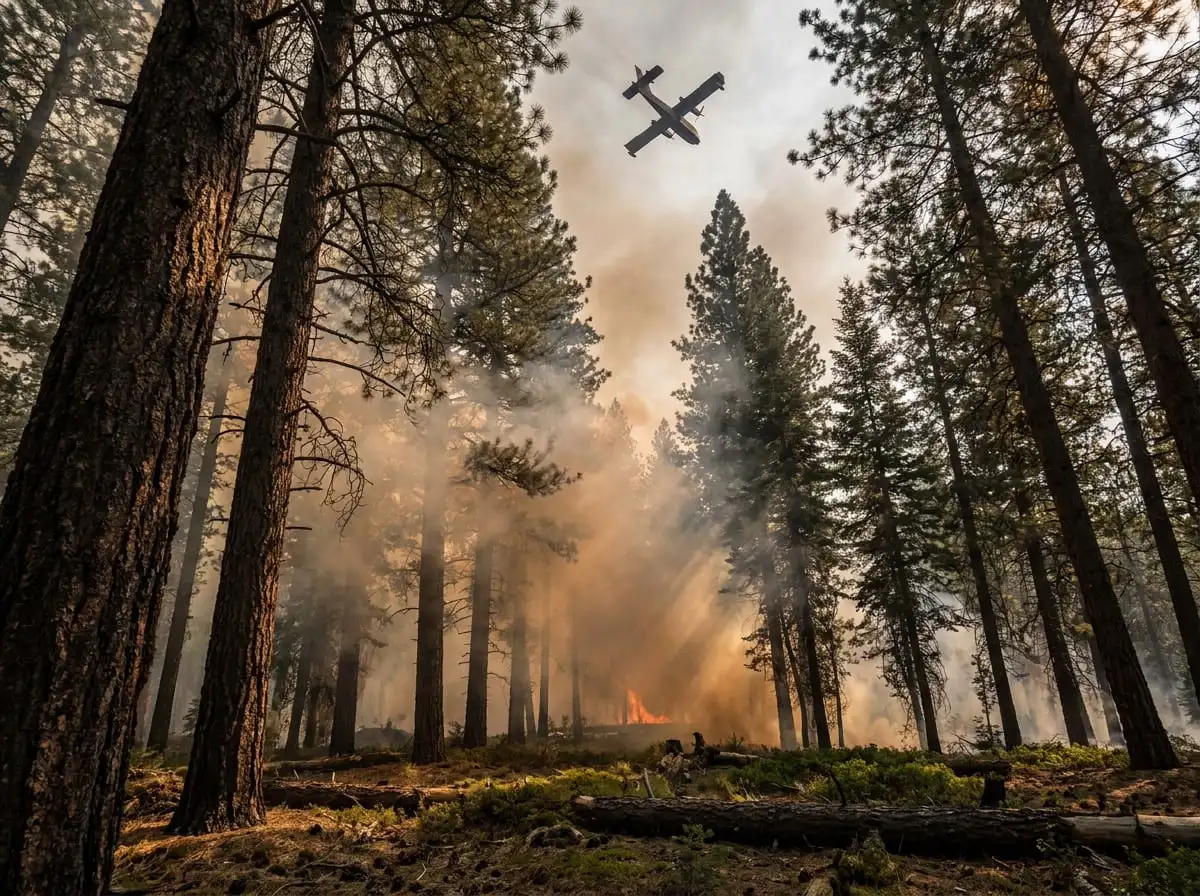

Let’s be real for a second: the way we handle forest fires hasn’t changed much in decades. We wait for a spark, we see the smoke, and then we scramble to throw everything we’ve got at the flames. It’s reactive, it’s dangerous, and quite frankly, it’s getting more expensive and less effective every year.
In California alone, we’ve seen millions of acres turn to ash. In 2020, over 4.6 million acres were burned. That’s not just a statistic; that’s ecosystems wiped out, homes lost, and air quality that makes walking outside feel like a health hazard. As climate change continues to crank up the heat and stretch out our droughts, the “tinderbox” effect is becoming our new normal.
At H2O Everywhere, we looked at this problem and asked a simple, maybe slightly crazy question: What if we stopped waiting for the fire to start? What if we could keep the forest from being flammable in the first place?
Welcome to the future of fire prevention. We’re talking about “Fighting Fire with Fog” using Atmospheric Water Generation (AWG) technology.
The Problem with the Status Quo
Traditional fire management usually falls into two categories: controlled burns and reactive firefighting. Don’t get us wrong, these are essential tools. Controlled burns help clear out the “fuel” (dead brush and dry trees), and our firefighters are absolute heroes. But these methods have limits. Controlled burns are risky and can only be done in perfect weather windows. And reactive firefighting? That’s just damage control.
The root cause of these catastrophic fires is simple: dryness. When soil moisture drops and vegetation loses its hydration, a single lightning strike or a stray campfire can trigger a disaster. We need a way to proactively manage moisture levels in high-risk zones without needing to build massive, expensive pipelines into the middle of the wilderness.
Enter Atmospheric Water Generation (AWG)
You might have heard of AWG as a way to create drinking water in desert cities or off-grid homes. But at H2O Everywhere, we see it as a massive environmental management tool.
The tech is essentially “pulling water out of thin air.” There are a few ways we do this:
- Cooling Condensation: Think of a cold soda can on a humid day. We cool the air below its dew point to turn vapor into liquid.
- Desiccant Systems: We use materials that act like those little silica gel packets in your shoe boxes to soak up moisture and then release it as water.
The beauty of AWG is that it doesn’t need a lake, a river, or a pipe. It just needs air and energy. And since we’re leaning heavily into solar power, we’re making this process as sustainable as possible.
The Future of Fire Prevention: Build “Wet Lines,” Not Fire Lines
Here’s the big idea: instead of spending every fire season chasing flames, we can change the starting conditions that make megafires possible in the first place.
Wildfires don’t become unstoppable because we “didn’t respond fast enough.” They become unstoppable because the landscape is already primed—soil moisture is gone, brush is brittle, needles are crispy, and humidity is nonexistent. In other words, the forest turns into a giant match.
H2O Everywhere’s AWG tech gives us a different playbook: create targeted pockets of moisture in the exact places that tend to ignite and spread, so a spark has a much harder time becoming a headline.
The “Magic” (That’s Actually Just Smart Engineering)
AWG is the closest thing to science-fiction that’s already real: our machines pull water out of thin air and turn it into usable, on-site water—no rivers, no pipelines, no tanker convoys.
In practical terms, that means we can:
- Keep soil and duff layers slightly damp (the stuff that normally turns into ember food)
- Maintain healthier, less-stressed foliage during peak drought months
- Create localized “humidity + moisture bubbles” in ignition zones where fires love to start
This isn’t about watering the entire forest. It’s about being surgical: reinforcing the dry, windy ridges, corridors, and access points that repeatedly light up year after year.
We have Two-tier hardware approach:
- The Big Guns: Massive 200-gallon AWG machines. Half of these will be hooked up to irrigation drip technology, slowly feeding moisture directly into the soil. The other half will use sprinkler systems to keep the foliage damp.
- The Solar Sentinels: Smaller, 15 to 20-gallon machines. These are the “special forces” of the fleet. They are entirely solar-powered and can be placed in remote, hard-to-reach areas. Each one has its own sprinkler system to create localized “moisture bubbles” in the forest.
Solar-Powered, Self-Sufficient, and Built for the Middle of Nowhere
A lot of “solutions” fall apart the second you leave the grid. That’s where AWG gets really interesting.
H2O Everywhere units can be deployed with solar power so they can operate as self-sufficient infrastructure deep in remote forests—places where:
- running pipe would be a multi-year, multi-permit nightmare
- hauling water is expensive, slow, and sometimes impossible
- permanent water storage creates its own environmental and logistical issues
Think of them as solar sentinels—quietly generating water, feeding drip lines or sprinklers, and keeping critical zones from ever reaching that bone-dry tipping point.
Why This is a Game-Changer
If you’re a municipality leader or an environmental investor, you’re probably looking at the price tag. Yes, building and installing this tech costs millions. But let’s look at the alternative.
A single major wildfire can cost billions in property damage, healthcare costs from smoke inhalation, and firefighting expenses. Not to mention the priceless loss of biodiversity and old-growth forests. By investing in H2O Everywhere’s AWG systems, we are moving from a “spend billions to fix it” model to a “spend millions to prevent it” model.
The Benefits at a Glance:
- Localized Water Supply: No more hauling water trucks into the backcountry. We make the water right there.
- Low Environmental Impact: By using solar arrays, we ensure that our solution to climate-driven fires isn’t contributing to the problem.
- Precision Moisture: We aren’t trying to water the whole state. We are targeting the specific ignition zones that cause the most trouble.
Creating “Conditions Less Conducive to Wildfire”
Imagine a high-risk forest ridge during the peak of August. Normally, the ground would be crunching under your feet: a literal powder keg. But with H2O Everywhere units humming away in the background, that same ridge stays slightly damp. The air is a bit more humid. The plants are hydrated.
When that lightning strike hits? Instead of an explosion of flames, you get… nothing. Or maybe a small, slow-moving fire that’s easily contained because the “fuel” simply isn’t ready to burn.
That is the vision.
Join the Movement
We are currently looking for visionary partners, municipalities, and agencies who are tired of the “wait and see” approach to fire season. The technology is here, the logic is sound, and the need has never been more urgent.
At H2O Everywhere, we’re not just building machines; we’re building a shield for our forests. If you’re ready to see how innovation can protect our natural world, we want to hear from you.
Let’s stop fighting fires and start preventing them.
Want to dive deeper into the tech or talk about a wildfire-prevention deployment?
Reach out to H2O Everywhere to explore what a proactive, AWG-powered “moisture shield” could look like for your region—starting with the highest-risk ignition zones and scaling from there.
The air is full of water. It’s time we started using it to save our forests.