
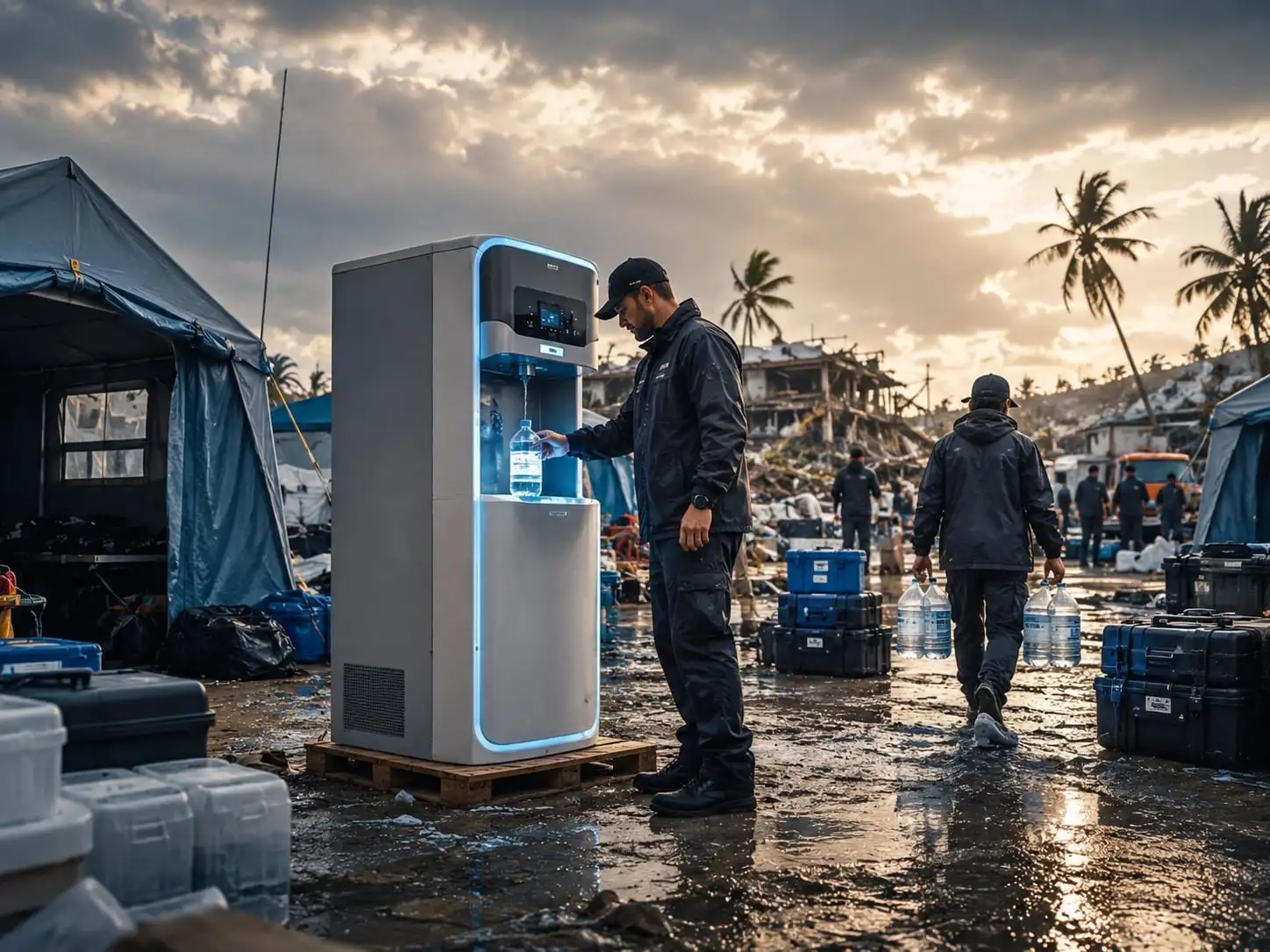

When a natural disaster strikes: be it a hurricane, earthquake, or a massive infrastructure failure: the clock starts ticking. The human body can survive weeks without food, but only days without water. In the high-stakes world of emergency management, the traditional methods of securing potable water are increasingly proving to be slow, fragile, and prohibitively expensive.
For years, the standard operating procedure has been a choice between two evils: waiting for a logistical miracle to deliver millions of plastic bottles or hoping that damaged groundwater infrastructure can be patched up before it’s too late. Neither is a sustainable solution.
Enter H2O Everywhere. By utilizing advanced Atmospheric Water Generation (AWG) technology, we are shifting the paradigm from “transporting water” to “generating water” exactly where it is needed most. Here is why AWG is the ultimate lifeline for emergency management and why it outperforms every traditional alternative on the market today.
The Fragility of Traditional Water Sources
In an emergency, your most reliable assets often become your greatest liabilities. Most municipalities rely on three main sources: groundwater/wells, surface water, and desalination plants. During a crisis, each of these faces catastrophic failure points.
The Problem with Groundwater and Wells
Many believe that well water is a safe fallback during a disaster. However, groundwater is incredibly susceptible to contamination during floods or seismic events. When the ground shifts or water levels rise, sewage systems can overflow, and industrial chemicals can seep into the water table. A well that provided clean water yesterday can become a source of waterborne illness tomorrow. Furthermore, wells require electricity to pump. If the grid goes down, the water stays in the ground.
The Vulnerability of Desalination
Desalination plants are often touted as the “future” of water, but in an emergency management context, they are sitting ducks. These plants are massive, centralized pieces of infrastructure. They are high-value targets for cyber-attacks and are physically vulnerable to coastal storms. If a desalination plant goes offline, an entire region loses its supply. Even if the plant remains functional, the infrastructure required to move that water: the pipes and pumping stations: is often the first thing to break during a disaster.
The Logistical Nightmare: The Cost of Moving Water
One of the most significant challenges in disaster relief is the “last mile” problem. Transporting water is a logistical nightmare that drains resources, time, and money.
The Bottled Water Trap
When a crisis hits, the first move is usually to truck in pallets of bottled water. While this provides immediate relief, it is a logistical disaster.
- Weight and Volume: Water is heavy. A single gallon weighs over eight pounds. Trucking enough water to sustain a city requires thousands of vehicles, burning massive amounts of diesel and clogging roads that are already damaged or needed for emergency vehicles.
- The Plastic Crisis: After the water is consumed, you are left with millions of single-use plastic bottles. In a disaster zone, waste management is usually non-existent, leading to massive environmental pollution that complicates the recovery effort.
- The Supply Chain Bottleneck: If roads are washed out or blocked, the trucks can’t get through. If the supply chain breaks, the water stops.
The Pipeline Problem
Relying on desalination or distant reservoirs requires an extensive network of pipes. Building these pipelines costs billions of dollars and takes years, if not decades, to complete. In an emergency, these pipes are prone to bursting. Fixing a major water main during a disaster is a slow, labor-intensive process. You cannot wait for a three-week repair project when people are thirsty today.
H2O Everywhere eliminates these bottlenecks. By generating water from the air at the point of need, we remove the “transport” variable entirely from the equation.
Why H2O Everywhere is the Safer Alternative
Safety isn’t just about having water; it’s about the quality and security of that water. H2O Everywhere’s AWG machines provide a level of purity that traditional sources simply cannot match in a crisis.
Our machines utilize a rigorous four-stage process to ensure every drop is medical-grade quality:
- Sourcing: Drawing moisture from the air, avoiding the heavy metals and pathogens found in contaminated soil.
- Ozone Treatment: A built-in ozone system oxidizes the water, instantly neutralizing bacteria, viruses, and other contaminants.
- Mineral Filtration: We don’t just provide “wet” water; we provide healthy water. Our filters add essential minerals back into the water to ensure proper hydration and a crisp taste.
- Dispensation: On-demand, clean water without the risk of stagnant growth in storage tanks.
Unlike a centralized water plant, H2O Everywhere machines are decentralized. If one unit is damaged, the others continue to function. This “mesh” style of water security is exactly what modern emergency management requires.
Environmentally Friendly and Energy Efficient
The environmental cost of traditional emergency water solutions is staggering. Between the carbon emissions of thousands of delivery trucks and the brine byproduct of desalination plants, the “cure” often harms the environment further.
H2O Everywhere was built with a different philosophy. Our machines are designed to be:
- Scalable
From the TIFFANY residential model to military-grade units capable of producing thousands of liters per day, our technology scales with the need. Emergency responders can deploy small units to individual medical tents or massive units to serve entire neighborhoods.
- Low Energy Consumption
Traditional AWG systems were often criticized for high energy use. H2O Everywhere has engineered a new standard. Our machines are highly efficient, squeezing the maximum amount of water out of the air with minimal kilowatt usage.
- Solar-Powered Independence
Perhaps the most revolutionary aspect of our technology for emergency management is our solar compatibility. In many disaster scenarios, the power grid is the first thing to fail. H2O Everywhere offers machines that can rely strictly on solar power. This means that as long as the sun is shining and there is air to breathe, there is water to drink. No fuel, no grid, no problem.
A New Standard for Emergency Responders
For NGOs, government agencies, and private emergency response teams, the goal is always resilience. True resilience means being self-sufficient.
Relying on a water bottle delivery that might be delayed by a storm is not resilience. Relying on a well that might be contaminated by floodwaters is not resilience.
Resilience is having a machine on the ground that creates clean, mineralized water out of thin air. It’s having a solution that doesn’t create a mountain of plastic waste. It’s having a system that can run on solar power when the rest of the world is in the dark.
H2O Everywhere isn’t just a piece of equipment; it’s a strategic advantage. In the face of increasing climate volatility and aging infrastructure, the ability to generate water on demand is the difference between a managed crisis and a total catastrophe.
Conclusion: The Future of Water is in the Air
The old ways of managing water in an emergency are failing. They are too slow, too expensive, and too damaging to the planet. H2O Everywhere offers a path forward that prioritizes safety, logistical simplicity, and environmental stewardship.
By removing the need for expensive pipelines and the nightmare of bottled water logistics, we are empowering emergency managers to focus on what they do best: saving lives.
To learn more about our technology and how we are partnering with organizations to secure the future of water, explore H2O Everywhere and contact us to discuss deployment options.
The air around us is the world’s largest untapped reservoir. It’s time we started using it.